The operating model behind high‑performing content teams: How to scale without chaos

Marco Fredriksen
Founding partner
Founding partner

Organizations continue to invest heavily in digital platforms, AI-driven technology, content creation and customer experience design. Yet many still struggle to translate ambition into execution. Teams work hard, channels expand and tools multiply but results remain inconsistent. Content launches slip, brand consistency suffers and local markets repurpose assets in uncoordinated ways, resulting in what many teams describe as “organized chaos.”
A Target Operating Model provides the structure to overcome this gap. It defines how people, processes, governance and capabilities come together to support content at scale. It provides clarity on who does what, how workflows, how decisions are made and which skills are needed. Without it, even the best technology will underperform. With it, strategy turns into measurable outcomes.

The challenges are familiar when an operating model is missing. Campaigns get delayed because roles are unclear and approvals take too long. Different teams create conflicting versions of the same asset because workflows are not defined. Regional teams re-create content because they cannot easily reuse or adapt centrally produced assets. Even when organizations invest in DAM, PIM or CMS systems, inconsistent governance means processes remain fragmented. Content might be produced, but it fails to deliver the impact it should.
These issues are not caused by a lack of effort but from lack of structure. Technology may provide new possibilities, but without clear ways of working, organizations struggle to realize value. Teams compensate with ad-hoc solutions, quick fixes and “workarounds” that feel efficient in the moment but erode consistency over time.
A Target Operating Model aligns ambition with daily execution by making responsibilities, workflows and governance explicit. In multiple organizations, from retail to digital health, this shift has unlocked faster approvals, greater reuse and clearer ownership across content and channel teams.
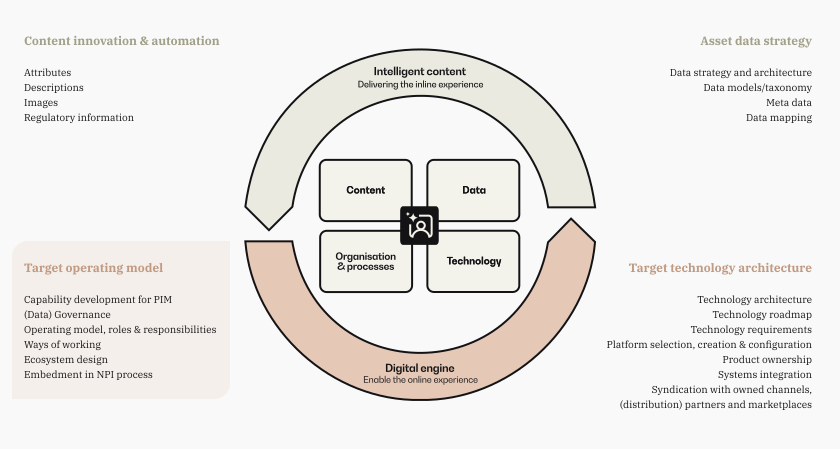
As companies accelerate investment in digital technology, the rise of AI-driven tools amplifies both the opportunity and the complexity. Generative AI, automation and predictive analytics promise speed and scale, but only if they are embedded into a clear operating structure. Without a Target Operating Model, AI risks becoming another layer of chaos: disconnected pilots, inconsistent guardrails and fragmented adoption.
To reap the benefits of AI, organizations need digital foundations that are aligned across content, data, technology, people and process. A well-designed Target Operating Model ensures these elements work together, enabling AI to enhance workflows rather than disrupt them. It provides the governance and clarity required to scale new technologies safely and effectively, turning innovation into sustainable performance.
At its core, a Target Operating Model supports organizations to provides clarity across four dimensions.
1. Roles and responsibilities create ownership. When it is clear who approves content, who manages the DAM or who drives analytics, duplication and delays are reduced. Accountability ensures that no content falls through the cracks.
2. Workflow design connects the steps of the Content Value Chain. From briefing to publishing, each stage is mapped so teams know what triggers the next action and where content lives. A well-designed workflow connects creative, channel, product and analytics teams so content flows predictably — even in global organizations.
3. Governance is the guardrail that enables speed. Clear brand, legal and quality standards prevent rework and ensure markets can adapt content safely. Strong governance also underpins metadata accuracy, enabling reuse and supporting automation later in the maturity journey.
4. Capabilities and training build confidence. Teams need skills in modular content, automation tools, data interpretation and cross-functional collaboration. Continuous training ensures organizations extract full value from their platforms and design choices.
A well-designed Target Operating Model encourages collaboration rather than sequential handovers. As roles and workflows become aligned, teams move from siloed activity to coordinated delivery. Many organizations experience a cultural shift: shared priorities, fewer misaligned expectations and more predictable execution.
This does not require rigid control. The strongest models create global consistency while allowing local flexibility. Markets can adapt to their realities without disconnecting from the overarching strategy — a balance that many organizations only achieve after clarifying their operational structure.
Operating models often fail when they remain theoretical. Successful ones are simple, visual and easy to adopt. Playbooks, process maps, decision trees and role descriptions help teams embed new behaviours into daily work. The aim is not heavy documentation, but practical tools people actually use.
Adoption typically follows a phased approach: early pilots, alignment sessions, onboarding and iteration. As workflows stabilize, teams gain confidence and the model becomes the default way of working. Organizations that followed this approach have seen shorter time-to-market, higher content reuse and clearer alignment across global and local teams.
Digital content will continue to grow as a driver of brand experience, ecommerce and personalization. Without structure, organizations scale their challenges instead of their capability. With a clear Target Operating Model, they gain predictability, quality and the confidence that strategy will translate into measurable outcomes.
The shift is more than operational, it is strategic. It shapes how teams collaborate, how content moves, how technology performs and how organizations grow in an increasingly digital market.
About the author: Marco Fredriksen is a Founding Partner & digital accelerator at FULL FORCE DIGITAL.
This article was originally published by Emerce.nl (in Dutch)